Average Height of Women Worldwide (2026 Update): Global Mean, Regional Differences, Tallest & Shortest Countries, and What Drives Height
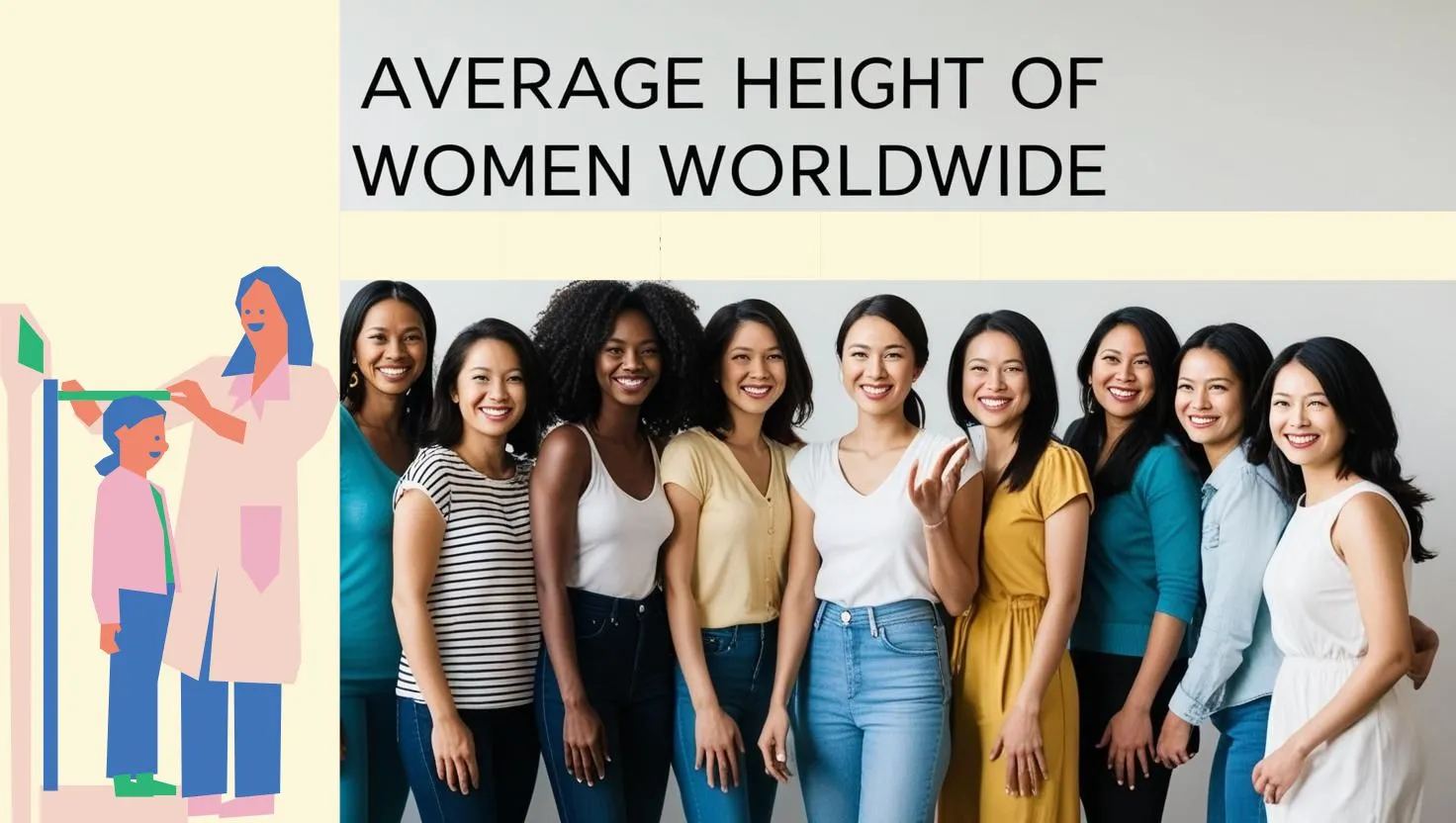
Women’s average height varies meaningfully across the world because height reflects a long chain of influences: genetics, childhood nutrition, infectious disease burden, maternal health, and broader socioeconomic conditions. Large international datasets consistently show a global gap of ~20 cm between countries with the tallest and shortest average female height—one of the clearest examples of how environment shapes human growth.
This guide consolidates the most useful, publishable facts and organizes them by global average, regional averages, and country extremes, with clear definitions so the numbers stay comparable.
Key Numbers (at a glance)
Estimated global average height for adult women: ~159–160 cm (about 5’3″) across commonly cited worldwide summaries.
Tallest average female heights (country leaders in major datasets): Latvia, Netherlands, Estonia, Czech Republic (often ≥168 cm in cohort-based global analyses).
Shortest average female height (frequently lowest in global cohort analyses): Guatemala (about 149.4 cm for women in the referenced cohort analysis).
United States (measured surveys): adult women around 5’3.5″ in 2015–2018 anthropometric reference data.
What “Average Height of Women” means (so comparisons stay valid)
Before comparing countries, you must know what a statistic represents:
Average height usually means the mean (not median).
Results vary by age definition (e.g., 18+, 20+, or 18–25), and by whether height is measured or self-reported (self-report is often biased upward).
Some of the most-cited global comparisons use birth-cohort approaches (tracking those born in a given year across countries) to compare height trends consistently.
In practice: if two pages cite “average height worldwide” without stating cohort/age/measured vs self-reported, they can disagree even when both are “correct” for their definitions.
Global Average Height of Women Worldwide
Across widely cited global summaries, the average adult female height worldwide is commonly placed around 159–160 cm (5’3″).
However, “worldwide average” hides enormous variation. A large pooled analysis of height trends describes women in the shortest country group as below ~151 cm, while the tallest countries exceed 168 cm, producing a global gap of roughly 20 cm.
Average Height of Women by Region (comparative overview)
The table below is a practical regional snapshot used for fast orientation. Regional averages are inherently approximate because each region contains many countries with different height distributions.
Regional Averages Table (Women)
| Region | Typical Average Height Range (Women) | Notes |
|---|---|---|
| North America | ~160–165 cm (5’3″–5’5″) | U.S. measured survey references place adult women around 5’3.5″. |
| Europe | ~162–168+ cm (5’4″–5’6″+) | Several European countries lead global female height rankings. |
| East Asia | ~155–163 cm (5’1″–5’4″) | Large within-region differences across countries and cohorts. |
| South Asia | ~150–158 cm (4’11″–5’2″) | Strong sensitivity to childhood nutrition and health conditions. |
| Sub-Saharan Africa | ~155–165 cm (5’1″–5’5″) | Wide variation; some areas show slower height gains across time. |
| Latin America | ~150–162 cm (4’11″–5’4″) | Guatemala is frequently at or near the shortest global female averages in cohort analyses. |
| Oceania | ~160–166 cm (5’3″–5’5″) | Australia/NZ tend to sit nearer higher-income country averages. |
Tallest and Shortest Countries for Women’s Average Height (what the strongest datasets agree on)
Because “by country” tables vary by dataset definition (age group, cohort year, and measurement method), the most honest approach is to publish robust country conclusions that repeat across reputable sources:
Countries repeatedly appearing among the tallest average female heights
Latvia
Netherlands
Estonia
Czech Republic
These countries frequently show average female height surpassing ~168 cm in large pooled trend analyses, depending on cohort.
Countries repeatedly appearing among the shortest average female heights
Guatemala (often reported around 149.4 cm in global cohort analyses)
Other countries frequently clustered below ~151 cm in the same analysis include Philippines, Bangladesh, and Nepal (cohort-dependent).
The meaningful takeaway
The important ranking fact is not just “who is tallest,” but that the height gap between the tallest and shortest female populations is about 20 cm—a very large difference for a biological trait that responds to early-life conditions.
A Practical “Top vs Bottom” Comparison Table (rank-intent format)
This table presents the most stable, repeatedly cited country extremes (not an over-precise list that depends on a single non-comparable dataset).
| Category | Countries commonly cited by major global analyses | Typical Average Height (Women) |
|---|---|---|
| Tallest cluster | Latvia, Netherlands, Estonia, Czech Republic | ≥168 cm in pooled cohort analyses |
| Shortest anchor | Guatemala | ~149.4 cm in pooled cohort analyses |
| Shortest cluster (often grouped) | Philippines, Bangladesh, Nepal | <151 cm (cohort-dependent) |
How women’s height changes over time (historical trend logic)
Women’s average height tends to increase when a population experiences improvements in:
maternal nutrition,
childhood protein and micronutrients,
sanitation and infectious disease control,
healthcare access and socioeconomic stability.
Global height trend work commonly evaluates changes across birth cohorts over a century-long timeline, which helps distinguish “genetic ceiling” from “environmental suppression.”
A key pattern: many countries gained height substantially across the 20th century, while others experienced slower growth or stagnation, often corresponding to persistent health and nutrition constraints.
What determines a woman’s height (rankable entity breakdown)
1) Genetics (inheritance and population background)
Genetics strongly influences individual height, but genetics does not explain rapid population-wide height gains in a few generations. Those changes are primarily environmental.
2) Early-life nutrition (protein + micronutrients)
Height is most sensitive to nutrition from pregnancy through adolescence. Protein adequacy, vitamin D status, and mineral availability influence bone growth and growth plate development.
3) Disease burden (infections and inflammation)
Repeated childhood infections can suppress growth by diverting energy from growth to immune response and by worsening nutrient absorption.
4) Maternal health and prenatal conditions
Birth weight, maternal nutrition, and prenatal care affect growth trajectory long before adulthood.
5) Socioeconomic conditions (income, food security, healthcare)
Population averages track broad conditions: stable food supply, public health, sanitation, and accessible medical care.
How to measure height accurately (so your number is real)
For consistent measurement:
Measure barefoot on a hard surface.
Stand upright with heels together; head level; eyes facing forward.
Use a flat object (book) at a right angle to the wall.
Measure to the nearest 0.1 cm (or 1/8 inch).
Measure at a consistent time—people are slightly taller in the morning.
Clinical settings use a stadiometer; home methods can be accurate if done carefully.
FAQ (publish-ready)
What is the average height of women globally?
Across commonly cited worldwide summaries, the global average for adult women is about 159–160 cm (5’3″), but the exact value depends on how “adult women” is defined and which dataset is used.
Which countries have the tallest women on average?
Large pooled analyses frequently place Latvia, the Netherlands, Estonia, and the Czech Republic among the tallest average female heights (often ≥168 cm in cohort-based comparisons).
Which country has the shortest women on average?
Global cohort analyses commonly report Guatemala among the shortest average female heights (around 149.4 cm in the referenced pooled trend analysis).
What is the average height of women in the United States?
Measured anthropometric reference summaries report adult U.S. women around 5 ft 3.5 in in 2015–2018.
Why is there such a big worldwide height gap?
A roughly 20 cm difference between the tallest and shortest countries is linked to long-run differences in nutrition quality, disease burden, maternal health, and socioeconomic conditions—especially during childhood and adolescence.