Garage Door Sizes: Standard Dimensions Chart
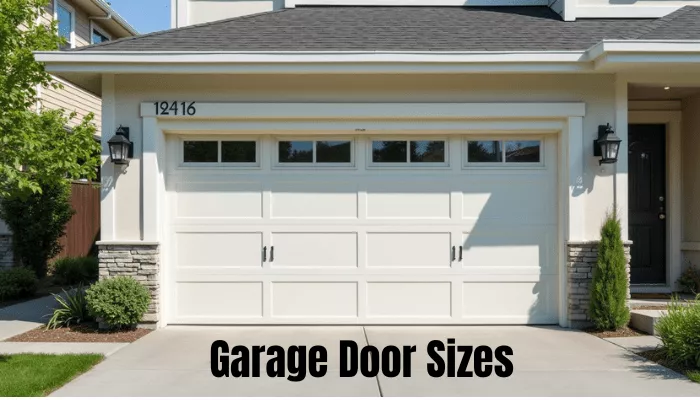
If you are searching for garage door sizes or dimensions, you typically need two answers: the most common “standard sizes” and the exact measurements of your opening so the door fits and the opener clears.
Standard garage door sizes in the US are typically 8 ft x 7 ft or 9 ft x 7 ft for a single-car garage, and 16 ft x 7 ft (or 16 ft x 8 ft) for a double-car garage. Always measure the rough opening plus headroom, sideroom, and backroom before ordering.
What are the standard garage door sizes?
Most residential “standard” sizing clusters around a few common widths and heights.
Standard single garage door sizes
Common single-car widths and heights include:
8 ft x 7 ft
9 ft x 7 ft
8 ft x 8 ft
9 ft x 8 ft
If you drive a wider vehicle (many SUVs and trucks), the extra width of 9 ft can feel noticeably easier day to day.
Standard double garage door sizes
The most common double-car size you will see is:
16 ft x 7 ft
Also very common in newer builds:
16 ft x 8 ft
Some homes go wider (18 ft) when owners want more clearance for larger vehicles, storage, or a more forgiving parking experience.
Common taller and specialty sizes (SUV, truck, RV)
If you have an oversized vehicle, roof rack, or RV bay, taller doors are often special-order:
Heights can go from 9 ft to 10 ft and beyond in some cases
The key is: do not guess. Measure your opening and confirm clearances.
Garage Door Size Chart (Width x Height)
Use this as a fast reference. Then jump to the measuring section to confirm what actually fits your garage.
Single-car garage door size chart
Most common:
8 x 7
9 x 7
Often chosen for bigger vehicles or extra vertical clearance:
8 x 8
9 x 8
10 x 7 (less common, but appears in “wider single” discussions)
Double-car garage door size chart
Most common:
16 x 7
Also common:
16 x 8
18 x 7
18 x 8 (more “comfort clearance” than “standard”)
RV and oversized garage door sizes
These vary heavily by build and are often custom. Many size guides mention wider and taller ranges for oversized needs.
Practical tip: measure your vehicle height, including antennas, roof racks, cargo boxes, and lifted suspension. Then measure the framed opening and verify opener clearance.
How to Measure Garage Door Dimensions (So You Order the Right Size)
This is where the most costly mistakes happen. Several top-ranking guides stress that you must measure more than just the “door.”
Step 1: Measure the rough opening (width and height)
Rough opening is the framed opening where the door will sit.
Measure the width across the opening at the widest point.
Measure height from the floor to the top of the opening.
Measure multiple points (left, middle, right) and record the smallest reliable measurement for height and the most consistent width.
Why it matters: A garage door system needs proper sealing and track alignment. Ordering based only on the old door panel size can be misleading if the opening has shifted, been reframed, or was incorrectly matched previously.
Step 2: Measure the sideroom (left and right clearance)
Sideroom is the space beside the opening where tracks and hardware sit.
Many standard track systems require a few inches on each side (exact requirement depends on your track and spring setup).
If you are tight on space, you may need a different track configuration rather than forcing a “standard” hardware kit.
Step 3: Measure headroom (space above the opening)
Headroom is the distance from the top of the opening to the ceiling/joists.
One common rule shown in buying guides: about 10 inches minimum for extension springs and about 12 inches minimum for torsion springs, with variations for low-headroom setups.
Also, remember the opener can require additional clearance.
Step 4: Measure backroom (depth into the garage)
Backroom is the distance from the opening to the back wall.
A common sizing rule in installer-style guides: backroom should be door height + about 18 inches (opener type can change requirements).
Common measuring mistakes (avoid these)
Measuring the existing door instead of the rough opening.
Forgetting headroom and then discovering the opener or track does not fit.
Ignoring sloped floors or uneven concrete.
Assuming all “16×7” openings are identical (they are not in older homes).
If you are replacing a door, measure the opening even if your old door “worked.” It may have been an imperfect fit.
7 ft vs 8 ft Garage Door Height: Which should you choose?
Ranking pages consistently point out that 7 ft is common, but 8 ft is widely available and increasingly chosen.
When a height of 7 ft is enough
Choose 7 ft when:
You drive sedans, compact SUVs, or smaller crossovers.
Your garage ceiling and headroom are limited.
You want the simplest replacement because your current setup is already 7 ft.
When 8 ft height is worth it (future-proofing)
8 ft is often worth considering if:
You drive a taller SUV or truck.
You use roof racks, cargo boxes, or bike mounts.
You want flexibility for a future vehicle upgrade.
Your garage layout allows it without tight headroom issues.
Practical rule: if you are building new (or reframing anyway), sizing up to 8 ft can prevent a “we should have done this earlier” moment later.
Single vs Double Garage Door: What works best?
Many homeowners compare “two single doors” versus “one double door,” and sizing guides discuss practical tradeoffs.
One double door (like 16×7 or 16×8)
Pros:
One opening, often cleaner look.
One opener (typically).
Easier to move large items in and out.
Cons:
If it fails, access can be more disruptive (you lose the main opening).
A bigger moving surface can be more sensitive to wind and alignment issues.
Two single doors (like 8×7 + 8×7 or 9×7 + 9×7)
Pros:
Redundancy: one door can still work if the other has an issue.
Often more flexible for daily use (open only one side).
Can look more balanced on certain home elevations.
Cons:
Often requires two openers.
Center post or framing may reduce usable width for very large items.
When You Need Custom Garage Door Sizes
Standard sizes cover many homes, but “custom” is common in these situations:
Older homes with nonstandard framing
Converted carports
Low-headroom garages that need special track solutions
RV bays or oversized vehicle storage
What to expect with custom sizing
Special ordering can increase lead time.
Hardware selection matters as much as door panel size.
A proper measurement can save money versus correcting a wrong order.
FAQs
What are the most common garage door sizes?
The most common single-car sizes are 8×7 and 9×7. The most common double-car size is 16×7, with 16×8 also very popular.
How do I measure for a replacement garage door?
Measure the rough opening (width and height), plus sideroom, headroom, and backroom to confirm tracks and opener clearance.
Is a 9 ft wide single garage door better than an 8 ft?
For many modern vehicles, 9 ft provides more comfortable clearance for mirrors and door opening, especially with SUVs.
Are garage door sizes standard across all brands?
Many sizes are common, but manufacturers and installers still rely on your measured opening and required clearances.
Can I get a taller garage door for a truck or RV?
Yes. Many guides note taller options (9–10 ft and more) may be available by special order, depending on your garage framing and clearance.