Burj Khalifa Height — How Tall Is the World’s Tallest Building?
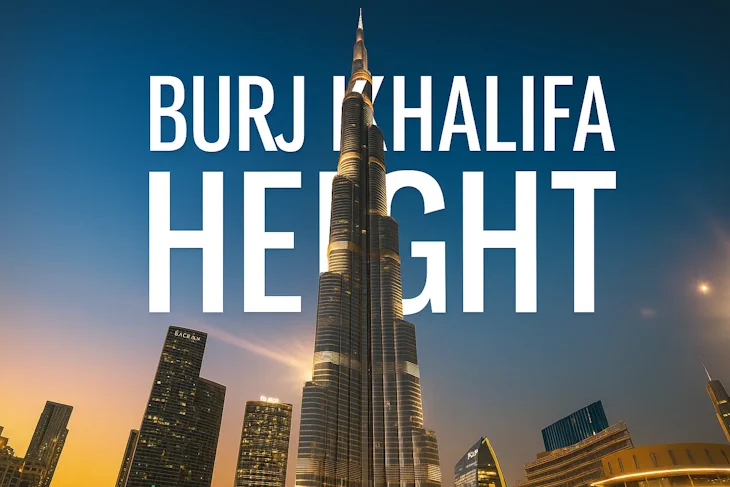
Quick Answer — Burj Khalifa Height in 2025
Architectural height (official): 828 m (2,717 ft)
Height to tip / total structural height: 829.8 m (~2,722–2,723 ft)
Highest occupied floor: 585.4 m (1,921 ft)
Observation decks: up to 555.7 m (1,824 ft)
Floors: 163 above ground (+2 basement levels)
Status in 2025: Burj Khalifa is still the tallest building in the world.
If you’ve ever asked “How tall is Burj Khalifa exactly?” — the short version is: just over 828 meters, and almost 830 meters to the very tip.
Official Height Measurements Explained (Architectural, Tip, Floors)
Several different “heights” are used when we talk about the Burj Khalifa height, and they don’t all mean the same thing.
1. Architectural Height — 828 m (2,717 ft)
What it means:
Architectural height is measured from the lowest main entrance at ground level to the architectural top of the building, including spires but excluding antennas, flagpoles, or temporary equipment.For Burj Khalifa:
828 m (2,717 ft) is the number recognized by the Council on Tall Buildings and Urban Habitat (CTBUH) and Guinness World Records.
This is the figure used in official rankings of Burj Khalifa as the tallest building.
2. Height to Tip / Total Height — 829.8 m (~2,723 ft)
What it means:
“Height to tip” includes every permanent element, even functional antennae or lightning rods.For Burj Khalifa:
829.8 m (often reported as 2,722–2,723 ft depending on rounding).
This is the absolute highest point of the structure.
3. Antenna / Spire Height
Burj Khalifa’s uppermost portion is a 242.5 m (796 ft) spire, which is an integral architectural element rather than a bolt-on antenna mast.
Spire height: ≈242.5 m (796 ft)
There is no separate tall antenna rising above the spire, so the height including antenna is effectively the same as the tip height: 829.8 m.
4. Number of Floors — 163 Above Ground
154 regular floors + 9 maintenance levels = 163 floors above ground, plus 2 basement levels.
These floors include:
Armani Hotel
Luxury residences
Corporate offices
Observation decks
Technical and mechanical levels
Burj Khalifa Height in Feet vs. Meters
Here’s a quick conversion overview for Burj Khalifa in meters and feet:
| Measurement | Meters (m) | Feet (ft)* |
|---|---|---|
| Height to architectural top | 828 m | 2,717 ft |
| Height to tip (including spire) | 829.8 m | ≈2,723 ft |
| Highest occupied floor | 585.4 m | 1,921 ft |
| Main observation deck (Level 124) | 452 m | 1,483 ft |
| SKY deck (Level 148) | 555–555.7 m | ~1,824 ft |
*Feet values are from official sources and CTBUH/Guinness, not just raw calculator conversions.
So when people search “Burj Khalifa in meters” or “how tall is Burj Khalifa in feet”, the safest answer is:
828 m (2,717 ft) to the architectural top, 829.8 m (~2,723 ft) to the very tip.
How Burj Khalifa Compares to Other Skyscrapers
Even in 2025, Burj Khalifa still dominates the tall-building league tables.
Burj Khalifa vs Other Tallest Buildings (Architectural Height)
| Rank (2025) | Building | City | Height (m) | Height (ft) | Floors |
|---|---|---|---|---|---|
| 1 | Burj Khalifa | Dubai | 828 | 2,717 | 163 Encyclopedia |
| 2 | Merdeka 118 | Kuala Lumpur | 678.9–679 | 2,227 | 118 |
| 3 | Shanghai Tower | Shanghai | 632 | 2,073 | 128 |
| 4 | Makkah Royal Clock Tower | Mecca | 601 | 1,972 | 120 |
| 5 | Ping An Finance Center | Shenzhen | 599 | 1,965 | 115 |
Gap to #2:
Burj Khalifa is roughly 149 m (489 ft) taller than Merdeka 118, the second-tallest building — about half a football field taller, straight up.
Comparison With Famous Landmarks (and a Moose!)
To make its scale more intuitive, here’s Burj Khalifa vs other buildings and things you know:
Burj Khalifa vs Iconic Structures
| Structure | Height (m) | Height (ft) | How They Compare to Burj Khalifa |
|---|---|---|---|
| Burj Khalifa (tip) | 829.8 | ≈2,723 | — |
| CN Tower (Toronto) | 553.3 | 1,815 | BK is ~1.5× taller. |
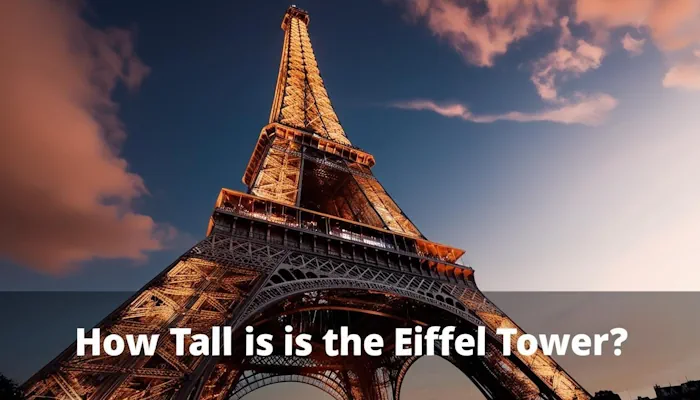
| Eiffel Tower (Paris) | 330 | 1,083 | You could stack ~2.5 Eiffel Towers to match Burj Khalifa. |
| Empire State Building (tip) | 443 | 1,454 | Burj Khalifa is almost twice as tall. |
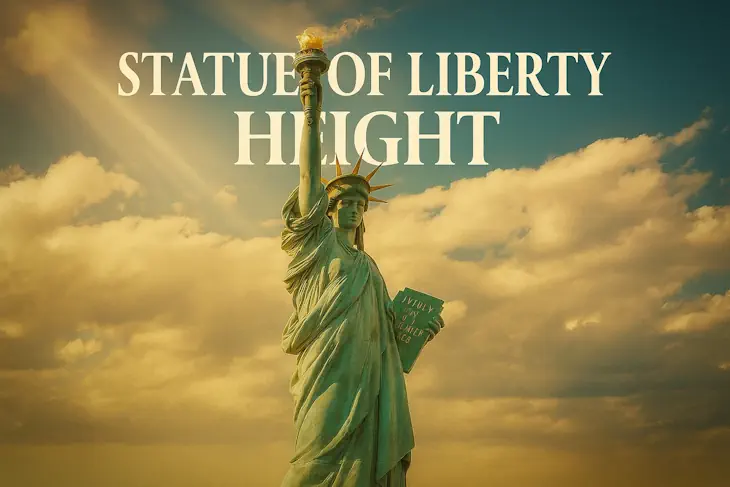
| Statue of Liberty (ground to torch) | 93 | 305 | You’d need ~9 Statues of Liberty to reach Burj Khalifa’s height. |
Burj Khalifa vs Natural Heights
Mount Everest: 8,848.86 m high. Burj Khalifa is about 1/10 of Everest’s height.
Distance to horizon from the top: From around 555–830 m up, the geometric horizon is roughly 100–103 km (62–64 miles) away, depending on your exact height and conditions.
Burj Khalifa vs Moose & Humans
Adult moose: around 1.8–2 m (6–6.5 ft) at the shoulder.
Average adult man (global): ~171 cm (5 ft 7 in).
Average adult woman (global): ~159 cm (5 ft 3 in).
So:
You’d need about 460 average men or 520 average women standing on each other’s shoulders to reach the top.
Or roughly 400–450 moose stacked nose-to-tail.
Ridiculous visual? Yes. Helpful for understanding scale? Also yes.
How Engineers Made It This Tall — Structural Secrets
Burj Khalifa doesn’t just rely on height; it relies on very clever engineering.
1. The “Buttressed Core” Structural System
The tower uses a Y-shaped plan with three wings around a central hexagonal core. Each wing buttresses (supports) the others, creating a very stiff, stable system.
The core resists twisting (torsion).
The wings act like structural fins, pushing back against the wind and gravity.
As the tower rises, it steps back in a spiraling pattern, which:
Reduces floor plate size
“Confuses the wind” — a phrase used by structural engineer Bill Baker — so wind vortices never align and cause dangerous oscillations.
2. High-Strength Concrete and Steel
The lower levels are built from high-performance reinforced concrete, strong enough to handle intense compressive loads.
Upper levels transition to lighter steel construction to reduce weight at the top.
3. Deep Foundation: Piles Buried ~50 m Into the Ground
Underneath the tower is a piled raft foundation:
~45,000 m³ of concrete and 110,000+ tons of material went into the foundation.
192 bored piles, each 1.5 m in diameter and about 43 m long, extend into rock, with the raft and piles working together to spread the load.
Piles and raft reach over 50 m deep below ground level.
This is what keeps an ~830 m tower from sinking into relatively weak sandstone and siltstone beneath Dubai.
4. Wind and Vibration Control
The spiraling setbacks means that no single wind pattern can set up a strong, regular vortex along the whole height.
The tower’s natural frequencies were tuned via extensive wind tunnel tests so that wind, structure, and human comfort align safely.
The result: Burj Khalifa can withstand strong desert winds and remains comfortable for occupants, even near the top.
How Its Height Is Officially Measured
The CTBUH height criteria define how tall buildings are measured worldwide.
Key standards:
Height to Architectural Top
From the lowest significant open-air pedestrian entrance to the architectural top, including spires, but excluding antennas, flagpoles, and signage.Height to Tip
From that entrance to the absolute highest point, including antennas or any permanent technical equipment.Highest Occupied Floor
From entrance to the highest floor that can be regularly occupied by people (not just maintenance).
For Burj Khalifa:
Architectural height: 828 m
Height to tip: 829.8 m
Highest occupied floor: 585.4 m
World’s tallest building in all these categories as of 2025.
Fun Height Facts You Didn’t Know
1. Elevator Travel Height & Speed
Burj Khalifa has 57 elevators, including some of the world’s fastest double-deck elevators.
They travel at up to 10 m/s (about 36 km/h or 22 mph).
Elevator “travel distance” record: about 504 m of vertical travel inside the building.
Time to reach Level 124 (452 m):
At 10 m/s, the trip is well under a minute — around 45–60 seconds in real operation (allowing for acceleration and deceleration).
2. Observation Deck Heights
“At The Top” (Levels 124 & 125): 452 m above ground.
“At The Top SKY” (Level 148): about 555 m (previously the highest observation deck in the world).
The Lounge (Levels 152–154): around 585 m, one of the highest lounges in the world.
3. How Far Can You See From the Top?
From around 550–830 m up, the geometric horizon is roughly 100–103 km (62–64 miles) away.
In exceptionally clear conditions, you can even see the shores of Iran, about 153 km away, from the top of Burj Khalifa.
4. You Can Watch the Sunset Twice
Because the tower is so tall, you can:
Watch the sunset at ground level.
Take the elevator up.
Watch the sun set again a few minutes later from the observation deck as your altitude extends the visible daylight.
Frequently Asked Questions (FAQ)
1. How tall is the Burj Khalifa exactly?
Short answer:
828 m (2,717 ft) to the architectural top.
829.8 m (~2,723 ft) to the very tip of the spire.
Both figures are “correct” — they describe slightly different measurement standards.
2. How many floors does Burj Khalifa have?
Burj Khalifa has:
163 floors above ground, plus
2 basement levels for services and parking.
3. Is Burj Khalifa still the tallest building in the world in 2025?
Yes.
As of 2025, Burj Khalifa remains the tallest building in the world, ahead of Merdeka 118, Shanghai Tower, and all other completed projects.
Some new towers are under construction, but none has surpassed its height yet.
4. Can you see Iran from the top?
Sometimes — yes.
From the highest observation areas, on very clear days, with low humidity and low tide, it’s reported that you can see the shores of Iran, around 153 km away.
On a normal day, you can reliably see dozens of kilometers across Dubai and the Arabian Gulf.
5. Will any tower surpass Burj Khalifa?
Almost certainly — but not yet.
Jeddah Tower in Saudi Arabia has resumed construction and is planned to be over 1 km (3,280 ft) tall, at least 180 m taller than Burj Khalifa, with completion tentatively expected around 2028.
Other proposals, such as Rise Tower in Riyadh (aiming for ~2,000 m), could someday go even higher, though these are still conceptual or early-stage.
Until one of these is actually completed and certified, Burj Khalifa keeps the crown.
Final Thoughts — Why Its Height Still Amazes the World
Even in 2025, with kilometer-high towers on the drawing boards, Burj Khalifa height still feels almost unreal:
It’s taller than two Empire State Buildings stacked.
Nearly three times taller than the Eiffel Tower.
About 1/10 the height of Mount Everest, but achieved with concrete, steel, and human design rather than tectonic forces.
Thanks to its buttressed core, deep foundations, and refined wind engineering, Burj Khalifa is more than just a record number — it’s a case study in how far high-rise engineering can be pushed.
So the next time someone asks “How tall is Burj Khalifa?”, you can do better than “very tall”:
It’s 828 meters to the top, 829.8 meters to the tip, 163 floors high, and still the tallest building on Earth.